Control evidence for AI coding agents
Agents write the code.
Your controls still apply.
AutoDevOps records every instrumented AI coding agent session — tool calls, prompt-submit events, policy decisions, approvals — and turns that record into evidence for the controls your examiners already test.
- Pre-production only
- Prompt text only on opt-in
- Built for your cloud · AWS validated
- 09:41:02session.startedclaude-code · payments-apiSR11-7.INV-01
- 09:41:09intent.bundle.attachedspec PAY-2141 · sha256:a41f…SR11-7.SND-02
- 09:41:33tool.startedEdit src/ledger/settle.tsEUAI.ART12-02
- 09:41:34approval.requestedconfirm · payments-writeEUAI.ART14-03
- 09:42:10approval.decidedapproved · second reviewer · rationaleFFIEC.SOD-01
- 09:43:05hook.blockedBash curl → public hostDORA.RES-03
- 09:43:41model.completed1 secret redacted before emitEUAI.ART15-04
- 09:46:01session.finishedPR evidence digest sha256:f9b0…FFIEC.SDLC-02SOC2.CC8-03
Controls with new evidence
9 / 16
On the record from
Capture statusMapped control-by-control
Reference mapping to evidence you produce — not a certification.
01The control gap
Every SDLC control assumes a person wrote the change.
Change management, dual control, attribution, and logging were designed around human authors. When an agent writes the change, the evidence breaks exactly where examiners look first.
Ask these five questions about the last change an agent merged in your repos.
- FFIEC.SOD-01
Who authorized this change?
Without a session record
A pull-request approval from a reviewer who never saw what the agent did.
With AutoDevOps
The approval record, bound to the session and the rule that fired, with the reviewer’s rationale when the decision was made in the portal.
- FFIEC.SDLC-02
Where did this code come from?
Without a session record
A commit under a developer’s name. The agent, model, and prompt are invisible.
With AutoDevOps
Session, agent, model, and commit bound into one pull-request evidence digest.
- SR11-7.SND-02
Did the agent build what was asked?
Without a session record
A ticket and a diff, with nothing connecting the two.
With AutoDevOps
The spec attached to its session, with a deterministic intent-fidelity score.
- EUAI.ART12-02
Can the log be trusted?
Without a session record
Shell history on a laptop, if anyone kept it.
With AutoDevOps
Signed events in an append-only ledger, exported through hash-chained evidence packages.
- DORA.RES-03
What happens when review is unavailable?
Without a session record
The agent keeps going.
With AutoDevOps
The action is denied, and the block is written to the record.1
1 Approval gates and fail-closed blocking ship in the customer-cloud distribution. The public CLI records telemetry.
02How it works
From agent session to control evidence.
One loop — the same on a laptop, in CI, and in cloud workers. Every step writes to the record; the control catalog maps each kind of record to the controls it supports.
01
Capture
Hooks in Claude Code, Cursor, and Codex emit signed events for sessions, prompt submits, and tool calls. Agent actions only — never keystrokes or screens.
02
Decide
Deterministic policy resolves each sensitive action to allow, confirm, or block before it runs. Confirm waits for a named reviewer.1
03
Record
Decisions, approvals, and any rationale given land in an append-only ledger. Secrets are redacted before anything is emitted.
04
Prove
Evidence packages and pull-request digests bind the record into files an examiner verifies offline — no raw prompts or source inside.
Approval queue · FinCard demo workspace · fictional data
Allow · Confirm · Block1
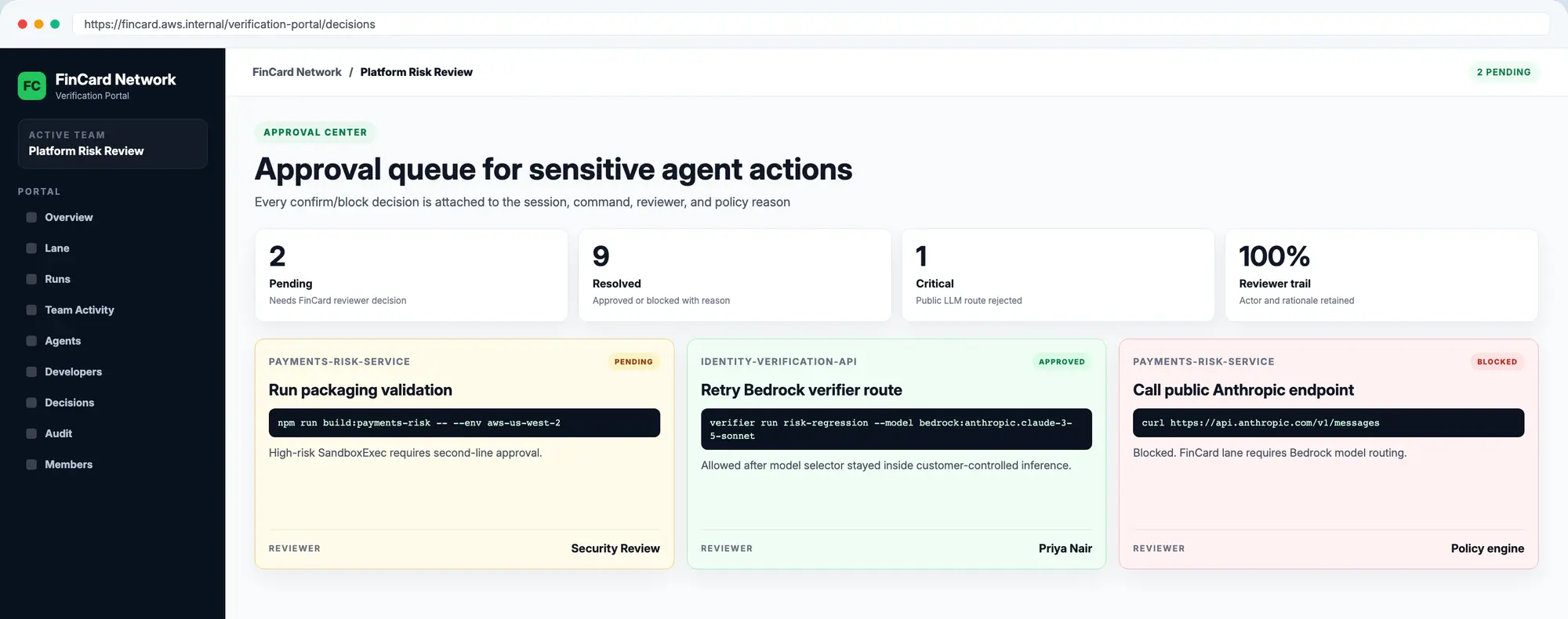
ConfirmEUAI.ART14-03
A high-risk command waits for a named reviewer before it runs.
ApproveFFIEC.SOD-01
The approval is bound to the session, the command, and the reviewer.
BlockDORA.RES-03
A public model call is denied, and the block is written to the record.
1 In the customer-cloud distribution, policy decides allow, confirm, or block before the action runs.
03The control catalog
16 controls. 6 frameworks. One record.
Each control names the clause it maps to, the artifact that evidences it, and a suggested reviewer role; your organization names the owner. Every row opens its full entry.
Reading the catalog
- Implementation evidence
- Runtime or portal behavior produces related evidence as agents work. It does not mean the control is operating in your environment.
- Monitoring signal
- A signal the portal computes on read from recorded sessions and approvals.
- Verifier-checkable
- An artifact a local verifier checks offline, without access to your systems.
- Needs your sign-off
- AutoDevOps produces the receipt; a named owner in your organization signs it.
A reference mapping to evidence you produce — not a certification, and not a statement that any control is met.
Open the full catalog04Controls as code
The policy file is the control implementation.
Governance, sensitivity, provider, and budgets — versioned in the repo and reviewed like code. The same file applies locally, in CI, and in cloud workers. The comments below show which catalog control each setting supports.
- Deterministic decisions
- Rules decide — never an LLM’s interpretation. Prior approvals let similar actions flow.
- Replayable audit
- Every decision replays with its context, on a laptop or inside a cloud worker.
- Budgets with reasons
- Per-commit, daily, and monthly limits. The run stops with the reason on record.
- Per-agent analytics
- Activity, cost, approvals, and risk per developer, team, and agent.
Policy · control notes added
Same contract everywhere# .verifier/config.yaml
governance: # DORA.RES-03 · policy blocks
enabled: true
mode: enforcement
sensitivity: # EUAI.ART14-03 · human oversight
enabled: true
confirm_threshold: 70
block_threshold: 95
providers:
bedrock: # DORA.TPRM-02 · your AWS boundary
region: us-east-1
budgets:
per_commit_tokens: 500005Proof surface
Evidence an examiner can verify offline.
Portal views compute from the ledger. The export is a hash-bound package an auditor verifies without access to your systems; the catalog maps each of its content sets to the controls it supports.
Operator view · demo data
FinCard demo
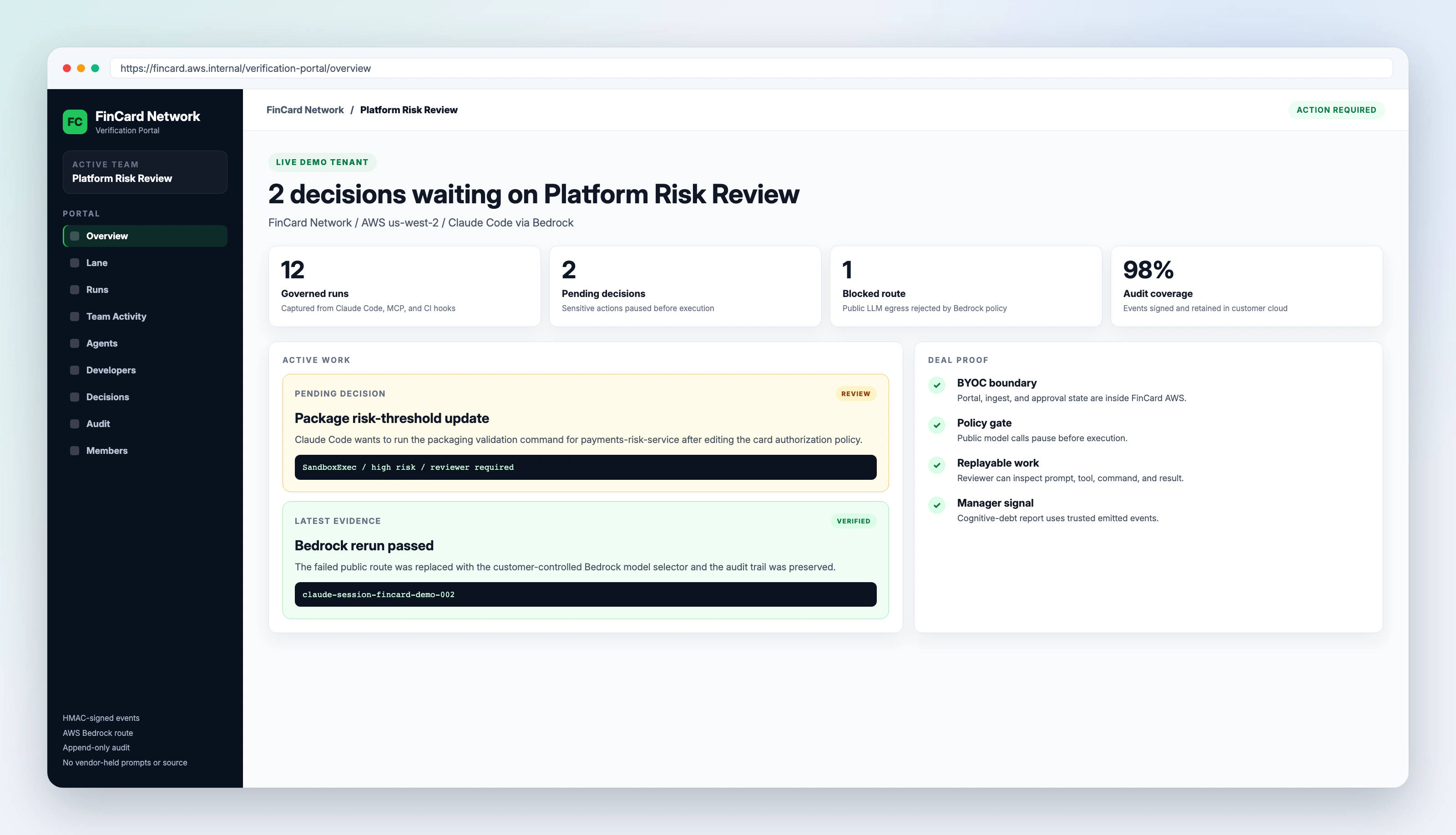
A demo workspace (FinCard, a fictional bank): sessions, approvals, and audit in one surface.
Evidence package manifest · excerpt, sample values
SHA-256 bound{
"schemaVersion": "autodevops.evidence_package.v1",
"packageId": "epkg_7f2a…c91e",
"generatedAt": "2026-09-30T09:52:07.214Z",
"exporter": {
"id": "exporter.evidence-package",
"version": "0.1.0"
},
"scope": { "kind": "pr", "id": "482" },
"redactionPolicy": {
"rawPrompts": "excluded",
"sourceContent": "hash_only",
"secrets": "scrubbed"
},
"sourceQueryIds": ["3f9c…e21a", "b7d0…4c58"],
"includedEventIds": ["0b4e…71c2", "1d93…a0f7"],
"contents": {
"agentRunAuditReports": { "rowCount": 3, "sha256": "71fd…" },
"approvals": { "rowCount": 2, "sha256": "9a07…" },
"policyDecisions": { "rowCount": 7, "sha256": "e2b4…" },
"prMergeEvidence": { "rowCount": 1, "sha256": "c0aa…" },
"provenanceQueries": { "rowCount": 2, "sha256": "5b93…" },
"sessions": { "rowCount": 3, "sha256": "4c1e…" }
},
"packageHash": "a4e8…9b2f"
}Shortened: a real export lists every included event and query ID, and every content set, empty ones included.
Content key → catalog controls
sessionsEUAI.ART12-02SR11-7.INV-01approvalsEUAI.ART14-03FFIEC.SOD-01policyDecisionsDORA.RES-03agentRunAuditReportsSR11-7.SND-02prMergeEvidenceFFIEC.SDLC-02provenanceQueriesDORA.ICT-01
Session and approval history
Never raw transcripts, prompts, or source.
Every signal traced
Each figure resolves to an audit record you can open.
Verifier included
A local CLI rechecks hashes, chains, and redaction offline.
06Scope, stated plainly
What the record proves. What you still attest.
Examiners trust evidence that knows its limits. Every mapping in the catalog separates what AutoDevOps produces from what your organization signs.
AutoDevOps produces
- Signed, normalized events from every instrumented agent session
- Policy decisions, each with the rule that fired
- Human approval decisions with the reviewer — and the rationale, which portal reviews require
- Hash-chained exports and offline-verifiable evidence packages
- Sign-off receipts for the thresholds your owners approve
Your organization attests
- Control ownership and the procedures around each control
- Model-risk and agent-trust threshold sign-off
- Validation of the deployment inside your own cloud
- The audit opinion — that belongs to your auditor
The regulatory mapping is a reference, not a certification. Customer-cloud validation of AutoDevOps itself is still open in every mapping.
07Capture
Collect from the agents you already run.
The public CLI installs telemetry hooks into Claude Code, Cursor, and Codex. There is no proxy in the model call path: agents emit, AutoDevOps records.
| Agent | Status | |
|---|---|---|
| Claude Code | Supported today | .claude/settings.json |
| Codex | Supported today | .codex/hooks.json and .codex/config.toml |
| Cursor | Supported today | .cursor/hooks.json |
| Copilot CLI | Roadmap | — |
| Other harnesses | Via SDK | JS/TS connector helper |
Claude Code, Cursor, and Codex are supported today with one install command. Copilot CLI is roadmap. Other harnesses, including Antigravity, Gemini CLI, and OpenCode, emit through the connector helper — they do not ship a hook pack. Product names and logos belong to their owners and indicate capture support, not endorsement.
Install the hooks
npm install -g @autodevops/verifier
verifier install --harness claude-code --mode telemetry
Telemetry mode records session, prompt-submit, and tool-use events. Prompt text is opt-in. Swap --harness for cursor or codex. The MCP server lets a session attach its spec.
Confirm it’s on the record
verifier harness doctor --harness claude-codeThe doctor command verifies the install receipt and files; events post once your portal credentials are set. Approval gates ship in the customer-cloud enterprise distribution.
Replay the session in the portal
FinCard demo workspace · fictional data
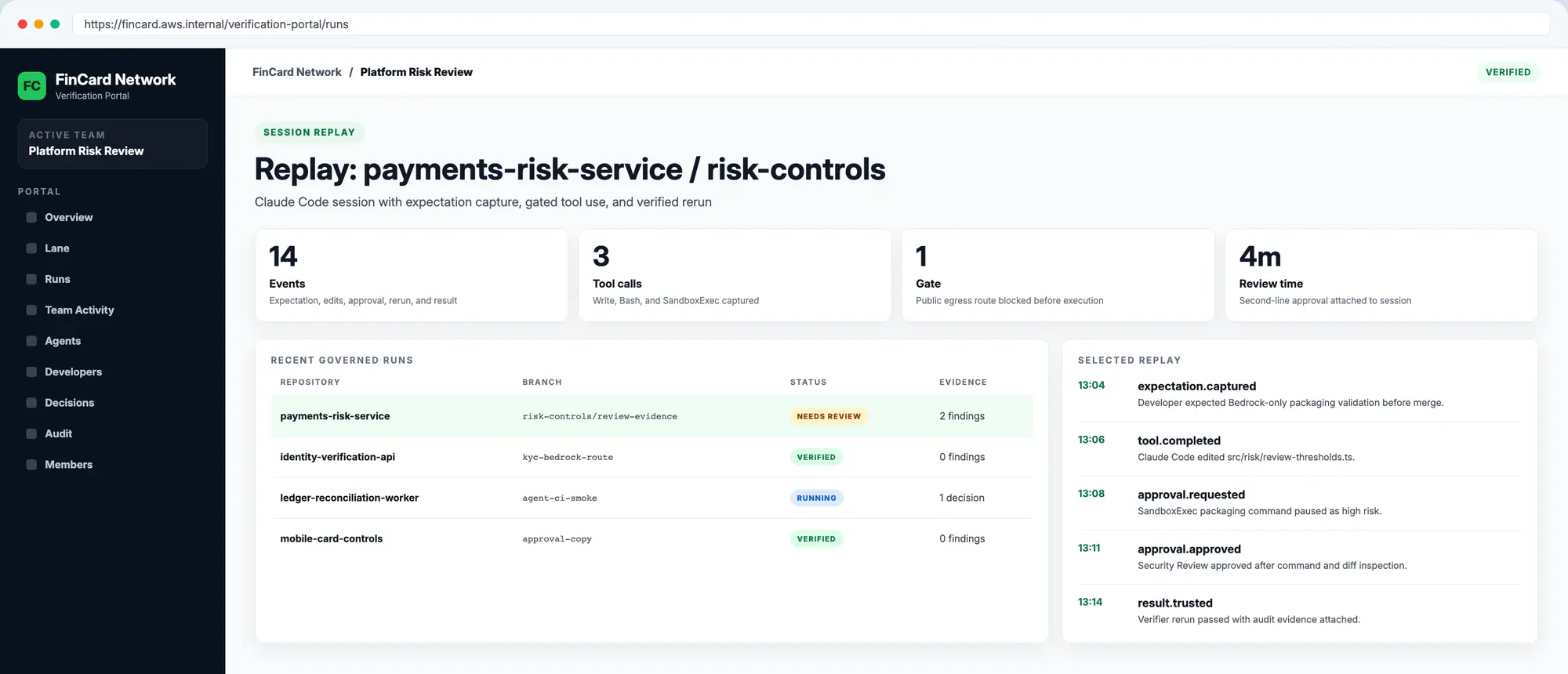
- 13:04expectation.capturedDeveloper expected Bedrock-only packaging validation before merge.
- 13:06tool.completedClaude Code edited src/risk/review-thresholds.ts.
- 13:08approval.requestedSandboxExec packaging command paused as high risk.
- 13:11approval.approvedSecurity Review approved after command and diff inspection.
- 13:14result.trustedVerifier rerun passed with audit evidence attached.
08Deployment
Built for your cloud. Owned by you.
AWS is the validated path today: Bedrock inference on your own credentials and an IAM-scoped worker deployed into your account. One-stack deployment of the portal, ingest, and storage inside your cloud is still in progress. Azure and Google Cloud adapter tracks are roadmap.
Where agents run
Developer laptops
Claude Code · Cursor · Codex hooks
CI pipelines
Verifier hooks on pre-commit and pre-push
Your AWS account
- In progress
Portal · ingest · ledger
Signed-event ingest, approvals, append-only audit
- Validated
Worker
IAM-scoped Lambda in private subnets; VPC endpoints, no general egress
- Validated
Amazon Bedrock
Model calls on your own AWS credentials
Amazon Web Services
ValidatedBedrock model calls on your own AWS credentials; IAM-scoped workers in private subnets with VPC endpoints and no general egress.
Microsoft Azure & Google Cloud
RoadmapAdapter code exists for Azure OpenAI, Functions, Vertex AI, and Cloud Run. Not yet customer-validated.
Boundaries
- Agent actions only
- No keystrokes, no screen capture.
- Pre-production scope
- Laptop, CI, and cloud workers. Never production traffic.
- Your cloud, your record
- Designed for BYOC, so prompts and source stay in the customer account.
- Allow · Confirm · Block
- Risky actions wait for a person when enforce mode is on.
Pick one of 16
Bring one control. Leave with its evidence.
Choose the control your examiners test first. We walk the validated AWS path with you — from agent session to approval to the evidence package that answers it.